
Original route-length calculator
Will the hose reach around the corner?
Measure two separate routes: faucet to reel, then reel to the watering point. The short connection hose, often called a leader, cannot also be counted as working hose beyond a fixed reel. A reel's storage capacity is a third number: it is not a guarantee of usable reach.
- Mark the proposed reel outlet. From there, lay a tape or loose cord along the route the hose must follow, around furniture and planted corners. Do not measure a straight line through a bed. Never pull a measuring cord tight across a walking route; remove it after measuring.
- Measure to the hand position. Include the height and position where you hold the nozzle at the farthest pot. Add only the extra movement you actually need, measured during a trial, rather than a universal percentage.
- Repeat for each watering area. Use the longest required route for one hose used in turn. Do not add distances to three different beds as though they were one continuous route.
- Measure the leader separately. Follow its proposed path from faucet to reel inlet, including bends and working clearance. Avoid a taut connection, a trapped door or a leader crossing the only walkway.
Enter all lengths in the same unit. Split one route into up to three segments. If it has more turns, add the remaining segments together in C. Use 0 for an unused segment. Leave unknown product lengths blank until you check the exact model's instructions.
Without JavaScript: working hose needed = A + B + C + extra movement. Working margin = usable hose − working hose needed. Leader margin = available leader − measured leader route. A negative margin means that section is too short. These calculations do not estimate flow, pressure or safe mounting loads.
Worked example: 50 feet can reach while the leader cannot
Suppose one route is 18 + 12 + 9 = 39 feet. A physical trial needs 4 more feet for movement, so the working requirement is 43 feet. A verified 50-foot usable hose leaves 7 feet beyond that allowance. Separately, a 6-foot leader route cannot be served by a 5-foot supplied leader. Buying a 75-foot working hose would not fix that missing foot at the faucet.
This is invented arithmetic, not a tested reel or a recommendation for 50 feet. Check whether a listing describes hose supplied, usable extension or maximum storage capacity. For retractable models, respect the manufacturer's extension limit and stop marker; never pull farther to make a marginal route fit.
Try the return path before paying for automatic rewind
Use a hose you already own if available. Walk its end back along the route and note each corner where it catches, cuts across planting or requires you to move furniture. A longer hose can reach a destination yet be awkward to put away. Try a different permitted reel position before adding more length or a powered mechanism.
If the route still needs a person to guide it around a corner, include that task in your choice. Do not let a spring reel drag a nozzle back unattended. Follow its instructions and never open the spring housing. For weak delivery after the layout works, use the separate flow-check record; this calculator cannot choose a diameter for you.
Check the leader against the exact model
GARDENA's legacy 15 m model lists a 1.5 m connection hose separately from its 15 m working hose. That illustrates why two lengths must be checked; it is not a current US buying recommendation. Its UK support page allows a specified extension method for RollUp boxes. Do not transfer that method to a different reel or region without checking its own instructions.
Sources checked September 20, 2026: GARDENA model 18402-20 specifications and GARDENA UK connection-hose guidance. The segmented measurement method and calculator are our own planning tools.
Record the route, support and storage space once
- Trace the real route. Measure from the faucet to the farthest bed around gates, corners and furniture. Choose the shortest hose that reaches without pulling tight. Include the separate leader connection from faucet to reel.
- Mark the moving footprint. Record width, depth and height with the lid, crank or swivel in use. Keep the gate and walking line open. Watch whether a box shifts or a cart tips during normal pulling; do not solve instability with an improvised anchor.
- Verify the support. Record the wall structure and the manufacturer's specified fasteners, not just the visible siding. If support or permission is unknown, use a suitable freestanding option or ask a qualified installer.
- Plan the return and winter route. Leave room to guide the hose into an even coil. Confirm how you will disconnect, drain and shelter it before a freeze. A spring cannot remove a sharp bend around a planter.
Route / leader length: ____ · Clear walking width: ____ · Full moving footprint: ____ · Approved support: ____ · Winter location: ____
For DIY storage, use a purpose-built hanger
A broad hanger on approved support can be enough for a short hose. Leave room for a loose coil and keep it out of the walking path. Do not suspend a heavy wet hose from thin siding or an adhesive hook. If hand coiling is the problem, a stable reel may be a better fit.
1. Manual wall reel: when floor space matters
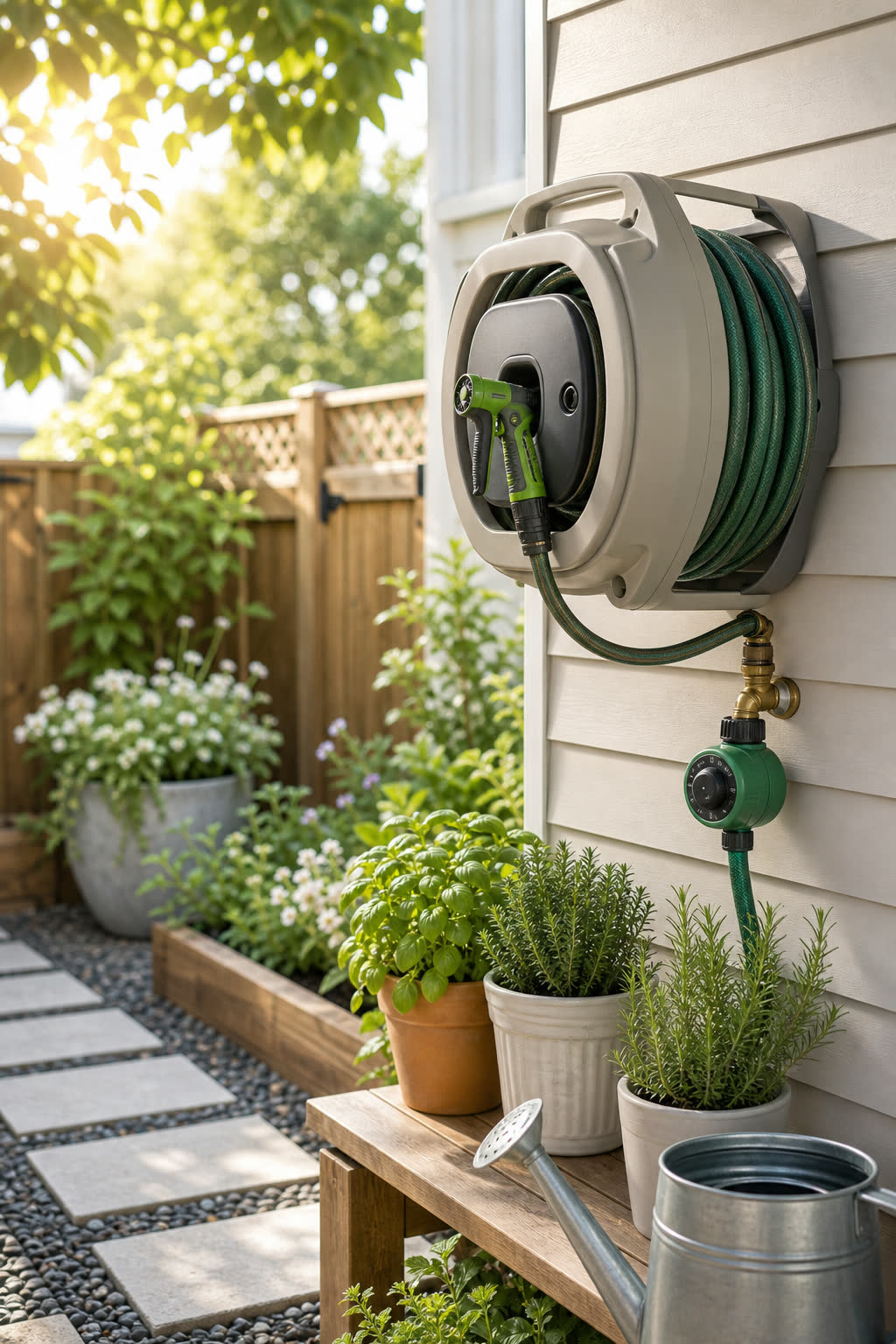
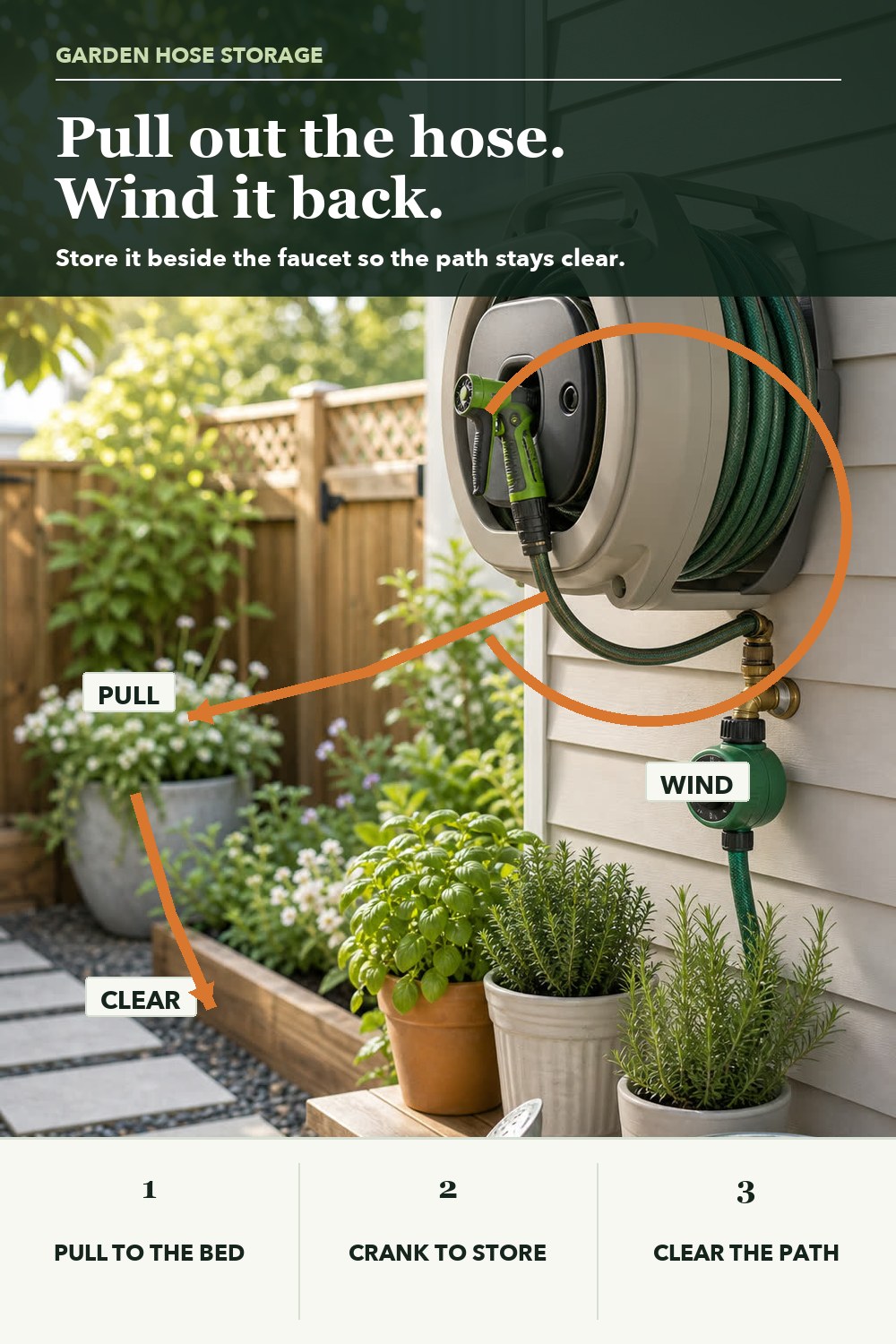
A manual wall reel keeps the hose in one known place and leaves the patio floor open. It fits a small yard when the faucet is beside a wall or post that can support the reel during pulling and cranking.
Measure the reel body and crank at their widest points. Confirm that the leader hose can reach the faucet without a tight bend. Look for a hose guide or a clear hand path so the hose can wind evenly instead of piling up on one side.
Skip a wall reel if you are unsure what the fasteners will attach to. The convenience is not worth a damaged exterior finish or an unstable mount.
Compare: Manual wall-mounted hose reelsCompare on Amazon
Affiliate link. As an Amazon Associate I earn from qualifying purchases.
2. Freestanding box: for renters and visible patios
A freestanding reel or hideaway box avoids drilling and keeps the hose visually contained. It can work beside a rental patio, brick wall, or exterior finish you do not want to disturb.
The tradeoff is floor space and stability. Measure the full base, leave room to open the lid or use the crank, and check how the unit is meant to resist a sideways pull. A light box can slide or tip when the hose changes direction around furniture.
Place it on a firm surface where water can drain. Skip the box if it narrows the main walking route or needs to be held with one hand every time you wind the hose.
Compare: Freestanding hose reel boxesCompare on Amazon
3. Retractable wall reel: when rewind effort is the problem
A retractable reel can make sense when the hose comes out several times a week and hand winding is the reason it stays on the ground. The benefit is quicker, more consistent storage, not a cleaner-looking case.
Check the full bracket width, swing arc, included hose length and diameter, lock positions, and the route back to the case. Look for clear information about replacing the hose, swivel, or rewind parts. A convenient mechanism becomes an expensive box if a common wear part cannot be serviced.
Skip retractable models when the hose must scrape around several sharp corners. The reel can pull the hose back, but it cannot remove friction from a poor route. Also skip it when the mounting location cannot safely carry the changing load of pulling from different angles.
Compare: Retractable wall hose reelsCompare on Amazon
4. Compact cart: when the reel must move
A cart is useful when one hose serves more than one faucet, the work area changes, or the reel needs to be stored away after each use. It is less convincing in a tight yard where the cart will sit beside one faucet and occupy a permanent patch of patio.
Measure the wheel-to-wheel width and handle height. Think about the cart with a wet hose on it, not as an empty frame in a product photo. Check whether the wheels match the route through grass, gravel, gates, and steps, and whether the loaded cart fits its storage space.
Skip the cart if it creates a second object to maneuver through the same narrow route as the hose.
If moving the reel is the main requirement, check the full loaded route and storage footprint first. Use our gate-clearance worksheet as a measurement aid; it does not rate hose-reel-cart stability.
5. Hose hanger: when a reel is more hardware than help
A simple wall or post hanger can be the better answer for a short hose near one faucet. It has no crank, swivel, or rewind mechanism to maintain, and it uses less depth than most reel boxes.
The hanger still needs suitable support and enough width for a loose coil. Do not force the hose into tight bends to make the coil look smaller. Keep the lowest loop clear of the ground and walking route.
Skip the hanger if lifting and coiling the hose is the exact repeated task you are trying to remove. In that case, a stable manual reel or a serviceable retractable reel solves more of the problem.
Compare: Outdoor hose hangersCompare on Amazon
Treat siding as a finish, not proof of support
Exterior walls vary. Eley Hose Reels' mounting guidance notes that most siding is not structural and that the correct fastener method depends on the wall structure behind it. That is manufacturer guidance, and the instructions for the reel you buy should control the installation.
Before ordering a wall reel, identify the mounting surface, read the installation guide, and confirm that the specified hardware matches that structure. Do not assume a fastener is correct because it arrived in the box. If the wall construction is unclear, use a freestanding option or get qualified installation help.
Also plan the working height and return path. A reel should sit above clear ground rather than over plants or a step, with enough room for the hose to return without scraping a sharp corner. Do not copy a universal mounting height from a different reel: use the manufacturer's clearance, then check that the crank, handle, and hose path are comfortable for the people who will use it.
Source: Eley Hose Reels mounting guide
Plan winter drainage before installation
Oregon State University Extension advises draining all water from a hose stored outside so residual water cannot freeze and split it. It also notes that outdoor temperature swings can age hose material faster even after the hose is drained.
Illinois Extension recommends disconnecting and draining hoses and storing them in a sheltered location. It warns that a hose left attached to a spigot can hold water that freezes back toward the spigot or house.
The useful buying question is simple: can this reel be disconnected, drained, and moved or protected before freezing weather? Check the product instructions for your climate and setup.
Sources: Oregon State University Extension and Illinois Extension
Check these details on the product page
- Hose capacity for the diameter and length you own, not only the largest number in the title.
- External width, depth, and height with the crank, handle, lid, or swivel in use.
- Leader hose length and connection position.
- Whether the hose is included or the listing is for the reel only.
- Mounting pattern and the hardware specified for your structure.
- Replacement availability for the hose, swivel, seals, or rewind mechanism.
- Drainage and seasonal storage instructions.
- Current return and warranty terms on the listing you are using.
Do not pay for more capacity until the larger reel still fits the storage zone. In a small yard, unused capacity can mean a wider box, a deeper bracket, or a heavier cart every day.
Original fault-isolation worksheet
Weak water at the end? Test before replacing the reel.
A reel organizes a hose; it does not create water pressure. Compare the same measured volume at the faucet and at the hose outlet. Then change one connection at a time. The result can identify where to investigate, but cannot certify a reel's hydraulic performance.
Set up a repeatable bucket test
- Use a stable container with a known volume and a timer. A marked 1-gallon container avoids lifting a full 5-gallon bucket. Keep children away and reuse collected water promptly where watering is needed.
- Test at the time you normally water. Record whether other taps, appliances or irrigation zones are running. Keep those conditions and the faucet setting the same for each comparison.
- First time the faucet filling your container. Keep required backflow protection in place. Next, lay the hose out without kinks and repeat at its open outlet, with the nozzle detached.
- Turn the supply off and release pressure before changing a connection. Where the product instructions permit, compare the hose without the reel against the assembled leader/reel/hose route. Never open a spring-loaded reel housing.
- Repeat each measurement. If repeated times differ substantially, resolve the changing supply or inconsistent test setup before blaming one component.
Copy this four-stage record
Container volume and unit: ____ · Faucet setting: ____ · Time of day: ____ · Other water use: ____
- A. Faucet, required protection retained
- Fill time 1 / 2: ____ / ____ seconds · Leaks: ____
- B. Hose alone, if a normal removable connection allows it
- Fill time 1 / 2: ____ / ____ seconds · Hose length/diameter: ____
- C. Complete leader + reel + hose
- Fill time 1 / 2: ____ / ____ seconds · Leader kink or swivel leak: ____
- D. Working nozzle attached
- Does the intended watering pattern work? ____ · Nozzle setting: ____
Gallons per minute (GPM) = container gallons × 60 ÷ seconds. Gallons per hour (GPH) = container gallons × 3,600 ÷ seconds. Multiply GPM by 60 to get GPH. For example, 1 gallon in 20 seconds = 3 GPM = 180 GPH. These are illustrative calculations, not product test results.
With liters, volume × 60 ÷ seconds gives liters per minute. Keep the volume and time units consistent. Compare manufacturer limits only after converting to the same units. An open-outlet bucket test does not measure pressure (PSI) or prove the flow available while irrigation is operating at its required pressure.
Use the result to narrow the purchase
A is already slow: the reel has not entered the test. Check normal supply conditions; ask the water provider or a qualified plumber about an unexplained change. A bucket measures flow, not PSI. A pressure rating printed on a hose is not your measured operating pressure.
B is slower than A: inspect the hose and normal removable couplings for sharp bends, visible damage or obstructed screens. Length, internal diameter, fittings and elevation can all affect delivery. Do not choose a larger hose solely from one bucket result: check weight, handling and the intended device's requirements too.
C is slower than B: inspect the leader route and accessible swivel connections using the manufacturer's maintenance instructions. Do not drill out a restrictor, remove backflow protection or assume an unrelated replacement swivel will fit.
C works but D does not: check the nozzle's setting and serviceable screen. If the open hose works but a soaker does not wet the bed evenly, use the irrigation distribution record. A longer watering time can leave the near end wetter without fixing the far end.
No-buy boundary: keep a serviceable reel when rerouting a kink or replacing an approved washer solves the fault. Compare the storage options above only when storage, rewind effort or mounting remains the actual problem.
Method basis: Rain Bird's separate flow and pressure checks. This staged comparison and record are our planning framework, not a pressure test, plumbing diagnosis or product endorsement.
When a hose reel will not fix the real problem
If the hose stays on the ground because the same beds need slow, repeated watering, compare drip irrigation and soaker hose setups before buying another storage product.
If the reel has nowhere dry to live because every tool is already on the patio, solve the storage zone first with the small-yard tool storage guide.
If you are choosing a cart because you need to move loads as well as water, compare the garden cart versus wheelbarrow guide. If you are still deciding which tool belongs in the yard at all, start with the small-yard garden tools hub before adding another object to the route.
If a short hose already reaches easily and takes less than a minute to coil, keep it. A reel should remove a repeated nuisance, not create another outdoor object to store and maintain.
Common questions
What type of hose reel is best for a renter?
A stable freestanding reel or hideaway box is usually the simplest starting point because it does not require drilling. Measure its footprint and check how it resists pulling before buying. A simple hanger is an option only if the lease and mounting surface allow it.
Is a retractable hose reel worth it in a small yard?
It can be when the hose is used often and hand winding is the reason it stays across the patio. Check the mounting support, hose route, replacement parts, and winter procedure first. For occasional use or a short hose, a manual reel or hanger is usually less hardware to own.
How much hose capacity should the reel have?
Match the reel rating to the hose length and diameter you use. Measure the real watering route before choosing either one. Do not buy a much larger reel solely for a capacity number if the extra body width or depth will block the small space you are trying to clear.
Should I mount a reel on brick veneer or siding?
Do not assume the visible finish is structural. Confirm what is behind it and follow the reel manufacturer's fastener instructions. If you cannot verify the support, choose a freestanding setup or get qualified installation help; a wet hose can add substantial pull and weight.