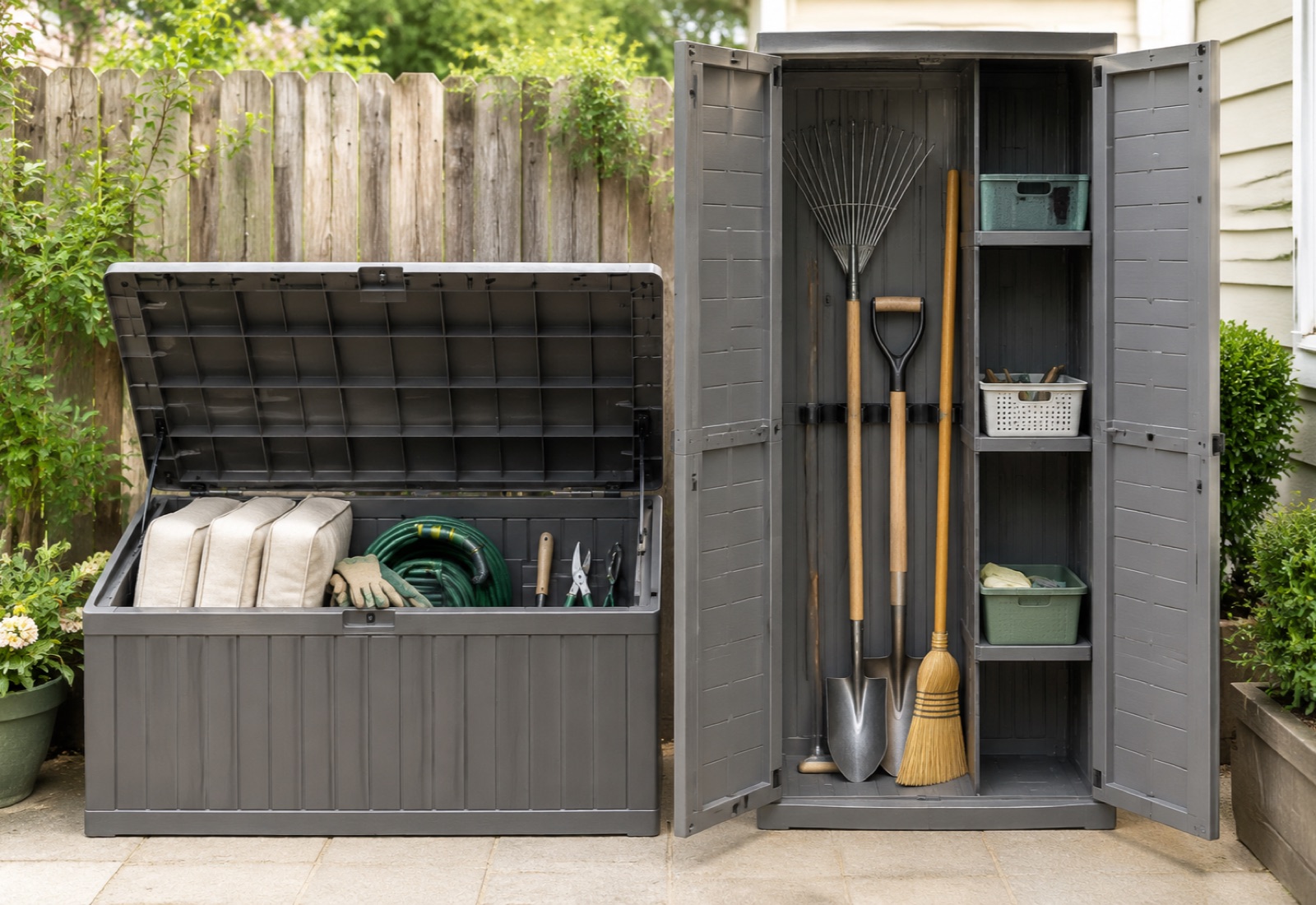
Measure before buying
Will storage leave a usable side-yard path?
Measure the narrowest clear width where the storage will stand. Measure between existing obstructions, not between property lines. Include a downspout, gate latch, plants, and anything you cannot move.
Remaining path = clear path − storage intrusion. Intrusion includes the installed gap behind the unit, handles, roof overhang, and loaded tool heads. Measure the closed and fully open states separately. Use the same unit for every input.
A 36-inch path and a real cabinet
The Suncast BMS1250 manufacturer dimensions, checked September 9, 2026, list an exterior depth of 25.5 inches. Its exterior width is 32.25 inches; the interior is 27 inches wide, 20.25 inches deep, and 69 inches high. Its clear door opening is listed as 27 by 68.5 inches.
36 − 25.5 = 10.5 inches remaining, closed. That calculation assumes no rear installation gap or other projection. It is already too little for an ordinary walking route. The product depth does not establish open-door clearance. Do not buy this cabinet for that 36-inch passage based on the word “vertical.” This is a worked example, not a recommendation or a verified match to an Amazon listing.
1. Keep the route
Do not obstruct an exit, rescue opening, utility access, or required route. Check local requirements and the installation manual. If the required clearance is unknown, the answer is “not verified,” not “fits.”
2. Check the moving state
Mark the full door or lid sweep with tape. Stand where you would lift out the longest tool. A positive leftover number does not prove you can turn, carry a load, or pass another person.
3. Choose another spot if needed
Move the cabinet out of the passage. Reuse a dry indoor storage zone, or consider a sheltered rack only after checking loaded projection and permitted structural mounting.
Copy this fit record before shopping
- Exact model and source date: ____
- Net path: ____; closed intrusion: ____; open intrusion: ____
- Remaining closed: ____; remaining open: ____
- Local route requirements and manufacturer installation clearance: ____ / unknown
- Longest tool enters without removing a shelf: yes / no / untested
- Gate opens, tool can turn, base stays dry: yes / no / untested
Do not seal wet tools into a box to protect them from rain. RHS tool-care guidance recommends cleaning, drying, and storing tools in dry conditions. A rain cover is not proof of dry storage. Follow separate label instructions for batteries, fuel, and chemicals.
Real yards are not product photos. Mud follows the shovel. Gloves stay damp in a sealed box. A rake can fit inside a shed and still catch the doorway every time you pull it out.
One big storage building is not always the answer. The hand tools used every morning may belong near the beds. Rust-prone tools need a dry spot. A mower or cart needs a wide, level route more than it needs an impressive capacity number.
Two public community discussions sharpen the problem. In a Permies storage thread, people compared garage, shed, and near-the-bed locations rather than naming one best container. A Houzz organization discussion also frames the issue as a workable return position for the tools that otherwise collect by a door. These are user examples, not controlled tests, but they point to a useful rule: storage distance and return friction matter as much as capacity.
Four problems product photos leave out
The storage is too far from the work
If the trowel is used beside the raised bed but stored in a shed across the yard, it will eventually stay by the back door, on a bench, or in the soil. That is a location problem, not an organization problem.
The space stays damp
A closed box can keep rain off while still trapping moisture from wet gloves, soil, or a hose nozzle. Metal tools need to dry before the lid closes. Check enclosed outdoor storage for nests or pests before reaching inside. Batteries, fuel, chemicals, and treated products need the storage conditions stated on their labels and manuals.
The opening is worse than the inside
A mower may fit inside a shed but not through its clear door opening. A rake may be tall enough for a cabinet but impossible to angle past a fixed shelf. Measure the opening, threshold, and turning space, not only the inside volume.
People put tools back where it is easiest
A household storage plan has to work for the person carrying the tool. A clearly labeled hook beside the door may outperform a perfect cabinet that takes two hands to open. Give frequently used tools one obvious return spot.
Rain leak, condensation, or wet tools?
Do not buy a tighter box until you know when and where the water appears. A roof can block rain while moisture still collects inside. A wet patch is a clue, not a diagnosis. Start with three observations: a dry afternoon, after rain, and the following morning. If no rain occurs, leave that observation blank; do not spray the cabinet to imitate a storm.
The EPA explains that water vapor can condense on cold surfaces, including the underside of a roof. That physical principle helps explain droplets without a visible roof hole. The source discusses buildings; its HVAC design advice is not a shed installation prescription.
Make the observations useful
- Move ordinary hand tools to an existing dry, secure place before investigating. Do not handle wet electrical equipment or open fuel or chemical containers to test storage.
- From a safe standing position, photograph the inside lid or roof, door seams, shelf and floor. Record existing wet spots before wiping ordinary accessible surfaces dry according to the storage maker's instructions.
- Remove wet gloves, soil-covered tools and damp fabric from the test space. Note what remains. Keep sharp tools out of reach of children.
- After rain, compare the same spots. Look for a trail from a seam, a wet threshold, splash near the base, or water outside the enclosure. Do not climb onto the roof or block drainage openings.
- Check again the next morning. Record scattered droplets, a single trail, damp contents or a dry interior. Note rain, temperature changes and whether the door was left open.
- Change one low-risk condition, such as removing wet items or clearing an existing vent as instructed, then repeat. One dry morning is not proof of weather resistance.
A trail appears after rain
Rain ingress is plausible. Inspect accessible joints and door alignment against the assembly manual. Photograph the trail for the manufacturer. Do not seal every gap: some openings are intended for drainage or ventilation.
Droplets appear on a cool morning
Condensation is plausible, especially under the lid or roof. It is not proven by timing alone. Keep intended vents clear and ask the maker about persistent moisture before adding insulation or drilling holes.
Only stored items stay damp
Check whether wet gloves, soil or cushions entered the box. Clean and dry suitable hand tools before returning them. Test without damp contents; a tighter lid does not dry them.
The floor or base is wet
Check nearby pooling, splash and the installation base. Solve the water route first. Do not raise a loaded shed on loose blocks or redirect runoff onto a neighbor.
Original observation worksheet
Three-check storage moisture record
Use the same enclosure and photo positions each time. More than one moisture source can be present.
No submission or site storage. Copy these notes or take a screenshot before leaving; reloading can lose entries.
Small Yard Starter · outdoor-tool-storage-ideas · Observation aid, not a leak certification, mold assessment or electrical safety check.
What the record changes about your purchase
A hypothetical example: the box is dry on Tuesday afternoon, has a trail below its hinge after Wednesday rain, and is still wet there Thursday morning. Start with the hinge and assembly instructions; Thursday's dampness alone does not prove condensation. In another case, droplets appear across the lid after a rain-free cool night. Investigate condensation, but keep checking for other sources. These examples are not product tests.
If removing wet contents resolves the problem in repeated comparable checks, improve the drying routine before replacing the box. If water enters despite correct assembly, ask about repair or warranty before buying a second enclosure. A cabinet with more volume is not evidence of better moisture control.
UGA Extension's tool-care guidance separates cleaning, drying and protecting tool materials. Follow the tool maker's care instructions; storage furniture cannot replace that maintenance. Keep batteries and power equipment within their own storage limits, even when ordinary hand tools appear dry.
Do not add a heater, improvised electrical supply, roof penetration or vapor barrier based on this checklist. Persistent damp, visible growth, damaged structure or wet electrical equipment needs appropriate manufacturer or professional advice. Desiccant is not a substitute for fixing bulk water entry, and outdoor ventilation does not guarantee dry air.
Only then compare the four storage roles below. Check the chosen model's weather exposure, ventilation, drainage, base and clearance instructions together. “Weather-resistant” is not a guarantee that every stored item will stay dry in your location.
Before winter storage: sort, clean, dry, then return
A larger cabinet does not make a dirty or damp tool ready for months of storage. Give each item a care decision before assigning its final position. Keep a separate, secure place for items awaiting repair so they cannot be mistaken for tools ready to use. Start with the tools you already own, not an organizer purchase.
This sequence covers ordinary hand tools. Batteries, chargers, fuel-powered equipment and chemicals need their own labels and manuals. Do not use the conditions tolerated by a shovel as permission to store everything else in the same shed. The UGA Extension tool-care guide starts with removing residue, drying and inspecting tools, with care suited to their materials.
Dirty but otherwise usable
Do: remove soil and plant debris using a method the maker allows. Clean before judging rust or damage hidden underneath.
Stop: before washing a powered unit or soaking parts not intended for immersion. A shovel-cleaning method is not a universal tool-cleaning method.
Clean but still damp
Do: allow the item and any washable case to dry in a suitable secure location before closing it into storage.
Stop: if the enclosure itself is wet. Use the rain-versus-condensation check rather than adding more dry items to the same damp space.
Cracked, loose or not moving normally
Do: label the fault and set the item aside for a manual-approved repair or service decision. Record the exact part or model.
Stop: before returning it to the ready-to-use rack. A clean appearance is not evidence that a damaged handle or joint is safe.
Ready for its storage conditions
Do: protect edges and moving parts as directed, then use the assigned dry, secure position. Keep the removal route clear.
Stop: if retrieval requires pulling several sharp tools out together or reaching behind an unstable stack. Change the layout before buying more capacity.
Separate a quick return from long-term storage
A tool needed tomorrow should be easy to retrieve without disturbing the seasonal group. A tool parked for months needs a label that tells you what care was completed and what remains unresolved. Put the next likely job beside its location in the record; this prevents hiding your regularly used pruners behind empty pots and a mower.
For example, a household may have a trowel used weekly, a rake used during leaf fall and a damaged lopper awaiting a part. The trowel belongs in the accessible dry-tool position. The rake needs a long-handle space with a clear lift-out route. The lopper needs a secure repair label, not a place among ready cutting tools. This is a hypothetical layout example, not a tested household setup.
Do not apply one preservation trick to every tool
Metal surfaces, wooden handles, coated parts and cutting pivots have different care requirements. Follow the maker's permitted lubricant, cleaner and protection method. Do not bury precision cutting tools in an abrasive sand mixture merely because a shovel-storage tip recommends it. Where the manual is unclear, ask the maker before adding a treatment.
Cleaning visible dirt is also not the same as disease-related disinfection. If a tool was used on affected plants, use appropriate Extension and product-label instructions for that task. Do not invent a chemical concentration, mix cleaners or use leftover motor oil as a general-purpose garden treatment. Handle cleaning materials and used cloths according to their labels rather than leaving them in the tool box.
Original seasonal return card
Ready, drying, or awaiting repair?
Use one card per awkward item, or copy the fields to paper. Entries are not submitted or stored by this site; screenshot before leaving.
Return test: retrieve one item without moving an unstable stack, then put it back without blocking a door. This checks your layout, not the rack's structural capacity; verify mounting and load ratings separately.
What this changes about the shopping list
If the tools fit after repair items and wet fabrics are removed, reuse the enclosure. If long handles still lack a supported return position, compare a suitable rack or tall cabinet. If the machine cannot enter or turn, measure the shed opening instead of buying another small box. Keep the existing four storage roles below; add no new product category unless a measured need remains.
Store detached watering parts with their labels, not loose among blades. The rain-barrel winter bypass card tracks which part must return to which connection. Neither card promises a maintenance-free winter; both make the next inspection and unresolved work visible.
A two-spot setup often works better than one shed
| Storage spot | Good candidates | What matters most |
|---|---|---|
| Small cache near the work | Hand trowel, gloves, pruners, kneeling pad | Quick access, drainage, and safe storage away from children |
| Dry, secure cabinet or garage zone | Rust-prone tools, power tools, batteries stored as directed | Drying, security, and manufacturer storage instructions |
| Wide-access shed or covered bay | Mower, spreader, garden cart, wheelbarrow | Door width, threshold, floor, and turning route |
Try these no-purchase fixes first
- Move an existing hook or tool rail closer to the garden if the wall and fasteners can support it.
- Use a covered bench compartment, retired mailbox, or small weather-resistant cache for the few hand tools used most often.
- Give each long tool one labeled return position instead of leaning the whole group in a corner.
- Let wet gloves and metal tools dry before closing them inside a box.
- Clear the path to the storage you already own. Sometimes the real problem is a blocked door or crowded threshold.
Do not place sharp tools where children can reach them, and do not repurpose a container for fuel, chemicals, batteries, or food unless its instructions and local rules allow that use.
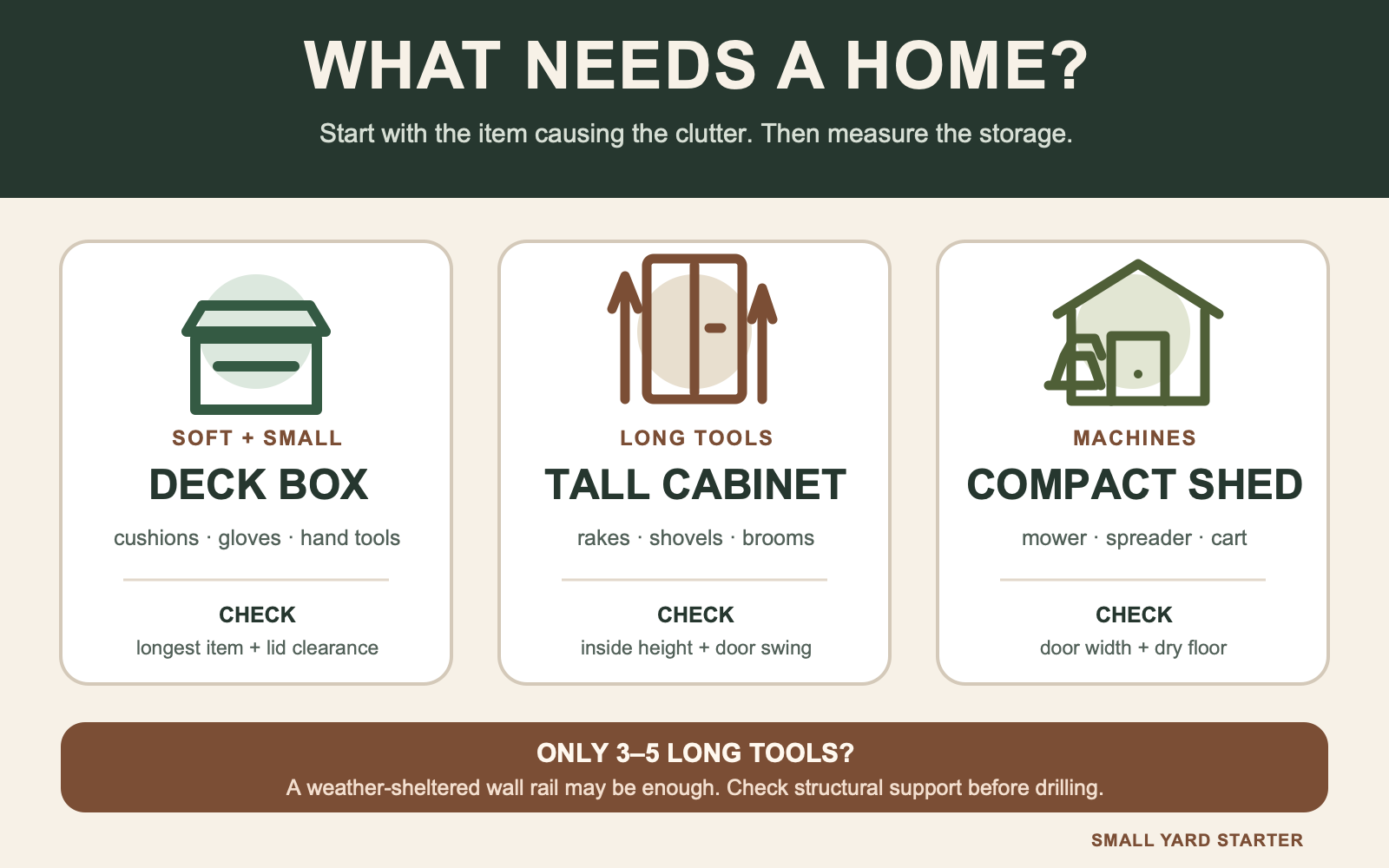
If storage is still needed, match it to the awkward item
| What needs a home | Start with | Measure first | Skip it when |
|---|---|---|---|
| Cushions, gloves, hand tools, small bags | Deck box | Longest item, lid clearance, inside dimensions | Long tools or machines are still left outside |
| Rakes, shovels, brooms, trimmers | Tall cabinet or vertical shed | Inside height, shelf position, door swing | The cabinet blocks the path or the tools must lie diagonally |
| Mower, spreader, garden cart | Compact shed | Door width, threshold, dry floor, turning space | The machine cannot roll through the opening without lifting |
| Three to five long tools on a sheltered wall | Wall rail or rack | Structural support, tool-head depth, weather exposure | Drilling is restricted or the tools remain in driving rain |
Take these five measurements before shopping
1. Measure the longest item
Lay the rake, broom, folded chair, cushion, or bag flat and measure its real length. Compare that number with the product's inside dimensions, not the exterior width in the title.
2. Measure the widest machine
For a mower, spreader, cart, or snow tool, measure the widest fixed point. Then measure the door opening. Leave room for your hands and for a wheel that is not perfectly straight.
3. Mark the footprint and the moving parts
Use tape or cardboard to mark the storage footprint on the patio. Open the nearby gate and house door. Add the storage lid or door swing. A box that fits while closed can still block the route every time you use it.
4. Check the floor after rain
Look for pooling water, roof runoff, soil splash, and a low edge where water collects. A larger shed does not fix a bad location. Follow the storage manufacturer's base, anchoring, clearance, and drainage instructions.
5. Walk the item to the storage spot
Carry the longest tool and roll the widest machine through the actual gate, corner, and step. If the route requires lifting a mower over a threshold or turning a cart sideways, solve that access problem before ordering storage.
Make a one-minute storage worksheet
Write these numbers down before opening a shopping tab. The limiting measurement is the one that decides whether the storage can be used, not the largest capacity number in the listing.
| Measure | Record | Why it changes the choice |
|---|---|---|
| Longest item | ____ in / cm | Rules out a low box when the handle must lie flat. |
| Widest machine or load | ____ in / cm | Sets the minimum clear door opening and route width. |
| Storage footprint | ____ W x ____ D | Shows whether the lid, door, gate, and body still have room. |
| Tightest route point | ____ in / cm | Prevents a container that fits at the destination but cannot arrive. |
| Wet or runoff zone | dry / splash / pooling | Determines whether the location needs a base, cover, drainage, or a different spot. |
Decision rule: choose the smallest format that clears the longest item, widest opening, full moving path, and required drying space. If any answer is unknown, wait or borrow a temporary container until the route is clear.
Deck boxes to compare
Use a deck box only for soft and small items
Start with one small-item box, not several similar capacities. The listing below is an existing example, not a fit-verified recommendation. Verify the exact model, exterior and interior dimensions, lid clearance, load limits, and return terms.
Small side-table footprint
Keter City 30 Gallon Storage Box
Compare this size when the pile is mostly gloves, hand tools, towels, or one compact cushion set. Skip it when the longest item must sit diagonally.
No-purchase alternative
Reuse a dry small-tool container
If an existing covered spot holds the real pile, keep it. Dry the tools first, label one return spot, and check access for children and pets. A second deck box does not solve long-handle storage.
Affiliate links. As an Amazon Associate I earn from qualifying purchases.
A tall cabinet solves one problem: long handles
A tall outdoor cabinet or vertical shed fits rakes, shovels, brooms, and some trimmers without using a wide floor area. The useful number is the uninterrupted inside height after shelves, hooks, and the roof shape take their share.
Make a paper strip as long as the tallest tool. Hold it inside the listed interior dimensions and check whether the tool can enter through the door without tilting into a shelf. Skip a tall cabinet when the base is too narrow to stay stable under the manufacturer's installation instructions or when the open door would block the only walkway.
Compare: Tall outdoor storage cabinets for long toolsCompare current options on Amazon
A compact shed earns its space when a machine needs a door
A mower, spreader, wheelbarrow, or garden cart can justify a compact shed. Start with the machine, not the shed catalog. Measure width, handle height, turning space, and the route over the threshold.
Check the manufacturer's base and anchoring requirements before choosing a location. A shed that sits out of level, catches roof runoff, or cannot open fully will be frustrating even when its advertised capacity sounds large.
Skip the shed when: the only clutter is cushions and hand tools, the door faces a narrow path, or the machine would have to be lifted in and out.
Compare: Compact outdoor sheds with a wide doorCompare current options on Amazon
Sometimes a wall rail solves the whole problem
If three to five long tools are leaning in one sheltered corner, a rail or rack can use less space than any cabinet. It also keeps the tool heads visible, so the rake does not disappear behind a door.
The wall finish is not proof of structural support. Follow the rack manufacturer's mounting instructions and confirm what the fasteners will attach to. Skip the rail when drilling is not allowed, the wall stays wet, or the tool heads would project into the walking route.
Compare: A rack for a sheltered, approved mounting locationCompare rack mounting details on Amazon
For a wall rail, start with the wall and the fastener route, not a product page. Confirm structural support, weather exposure, tool-head depth, and whether the stored tools project into the walking line. When drilling is restricted or the wall stays wet, a freestanding option may be safer even if it uses more floor space.
What to check on the product page
- Inside dimensions as well as exterior width, depth, and height.
- Clear door opening after hinges, frame, threshold, and shelves.
- Lid or door swing in the exact location where it will be used.
- Base, leveling, anchoring, wall-clearance, and wind instructions.
- Drainage, ventilation, and weather-exposure guidance.
- Whether shelves, hooks, floor panels, locks, or anchors are included.
- Current replacement-part, return, and warranty terms.
Do not assume a normal deck box or shed is safe for fuel, chemicals, batteries, food, or anything with special storage instructions. Follow the product label, storage instructions, and local rules for those items.
Four storage mistakes that waste space
- Buying by gallons alone. Capacity does not tell you whether a rake, cushion, or mower clears the opening.
- Measuring the empty spot only. The door, lid, gate, and your body need room to move.
- Hiding the wrong category. A deck box can tidy gloves while the mower and rakes still dominate the patio.
- Buying shelves before the storage arrives. Shelves can remove the vertical space that made the cabinet useful.
Common questions
Is a deck box big enough for garden tools?
It can hold hand tools and short supplies. Measure the longest item against the inside dimensions. Long-handled tools usually need a tall cabinet, vertical shed, or supported wall rail.
What is the smallest storage option for rakes and shovels?
A wall rail uses the least floor space when the wall has suitable structural support and some weather protection. A narrow tall cabinet is the next option when tools need a door.
How much clearance should I leave around a shed?
Use the manufacturer's installation, anchoring, access, and maintenance instructions. Also leave enough real working room to open the door, turn the machine, and reach every required fastener or panel.
Should I buy storage before organizing the tools?
No. Make the real pile first. Remove items that do not belong outside, group the rest by shape, and measure the awkward item. Storage is easier to choose after the pile has a clear job.
Source and limits
The September 17, 2026 update adds an original three-observation record. A Houzz discussion about a narrow shed and a Garage Journal discussion about tools in humid storage informed the questions. Their anecdotes do not establish a repair or prove one shed material better than another. EPA condensation guidance and UGA tool-care guidance support the limited physical and maintenance points linked above.
The real-yard failure modes above were informed by public Permies and Houzz discussions read on August 24, 2026. The recurring gap was not a lack of storage ideas; it was failure to match the storage location to tool frequency, clear opening, drying needs, and the route back to the work. Those accounts are useful examples, not controlled tests or universal rules.
The buying framework on this page is based on measurable fit: item dimensions, door openings, moving clearance, route, moisture, and the installation requirements shown by each manufacturer. Product listings, included parts, dimensions, and availability can change. The linked examples are not hands-on tests; verify the current listing and instructions before buying or installing anything.