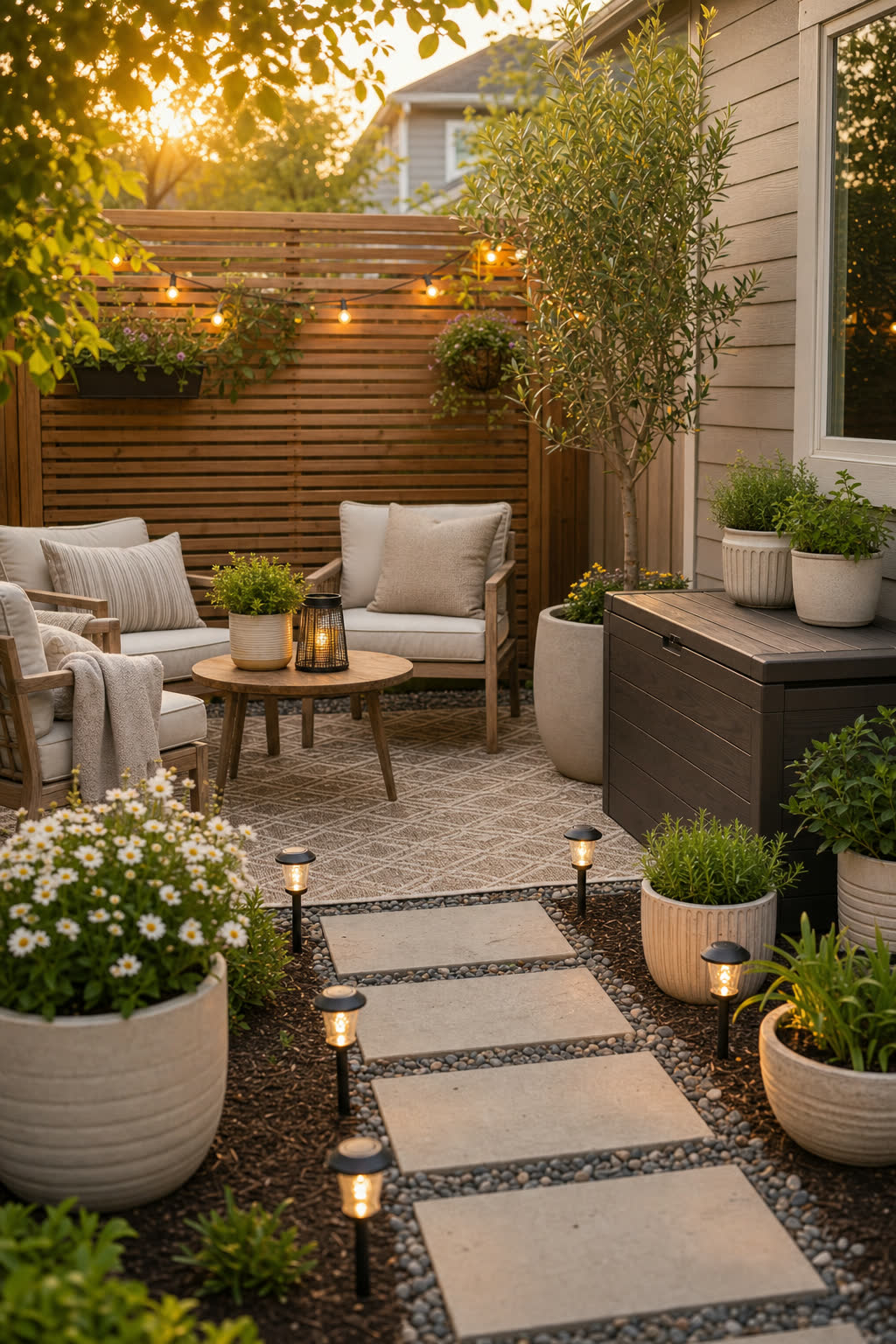
Cheap backyard makeover ideas only help when they fix something you notice every week. That might be a chair in full view of the neighbors, a patio that disappears after sunset, or cushions with nowhere dry to go.
Treat $500 as a planning ceiling, not a shopping target. Measure first. Pick one problem. Keep $100 unassigned until the main item fits and works. If the problem is solved for less, stop spending.
Original one-zone planning worksheet
What can you start without rebuilding the yard?
Choose the condition below before choosing a look. A photo of a finished patio does not reveal excavation, drainage, delivery or labor. Our three $500 plans assume the space already has a sound, usable surface where furniture will stand.
Sound patio or deck already exists
Start with a movable change: rearrange the chairs, contain small clutter or screen one seated view. Check doors, gates and the floor after rain. Price any required support before the decorative item.
First phase: one working seating zone. Keep the rest of the surface and sound furniture.
Bare ground needs a seating surface
A rug, loose mulch or a few unprepared pavers do not establish a stable patio. Get a site-specific surface and preparation quote, including excavation, disposal, access and labor.
First phase: define the footprint and obtain the full quote. If it consumes the budget, defer decor and use another existing usable space.
Slope, standing water or damage is present
Stop the makeover purchase. Record the wet area or visible defect. Use the water-route guide for observations, and get qualified help for structural damage or changes to grade.
First phase: establish the repair scope. This guide cannot specify a deck, retaining wall or drainage system from a photograph.
You rent or the permission is unclear
Confirm which changes and removal obligations the owner allows. “Movable” does not make a tall screen wind-safe. Avoid drilling, excavation or permanent work until permission and the installation method are clear.
First phase: a removable layout using sound items you already have. Include transport and eventual removal in any purchase decision.
Turn an inspiration photo into a measurable first phase
- Name the useful feature. Write “two seats outside the neighbor's direct view,” not “copy this patio.” Separate that function from the photo's paving, furniture and decoration.
- Draw only what exists. Mark the door swing, gate, drain, faucet, fixed furniture and the proposed zone. Measure at the narrowest points. Do not estimate distances from a wide-angle photo.
- Mock up the full moving footprint. Use your chairs and removable markers. Open doors, pull chairs back and carry the watering can or bin through the route. Account for a proposed box with its lid open. Remove markers when finished so they do not become trip hazards.
- Split the work into now and later. “Now” must function alone. A screen that needs an unpriced support is not a complete phase. “Later” may include a second planter or replacement furniture, but should not include a part needed for safe use.
- Write the acceptance test. For example: both chairs can be used, the gate opens fully, the bin passes, and cushions fit without compressing them. Repeat the relevant rain or evening observation before buying the next item.
Fill in your one-zone scope card
Use this on your phone during the layout trial, or copy it into your notes. These fields are not saved or submitted; keep your own copy before leaving.
Example: why a wider box can lose to the old one
Assume an existing passage measures 60 inches wide. A proposed box projects 24 inches into it, leaving 36 inches before any chair movement. A 26-inch bin leaves 10 inches total beyond the bin's width. That arithmetic does not prove comfortable or accessible passage: handles, your hands, turns and the open lid still need a physical trial.
If the bin must tilt or a chair must move every time, try another location or keep the smaller box. Do not buy a second item to work around a first item that fails the route. These invented dimensions illustrate subtraction, not a code-compliant clearance or a universal minimum.
Planning basis: Maryland Extension's landscape planning guidance supports inventorying the site and checking one phase before starting another. This scope card and trial are our own practical framework, not a construction design.
Next: price the measured quantities and complete first phase.
Original quantity worksheet
How many bags, and what is left after checkout?
Estimate a rectangular landscape bed, not a patio base. Enter the additional mulch depth needed after checking existing mulch. Use your supplier's bag volume and quote. Dollar inputs below are illustrative assumptions, not current prices.
Without JavaScript: volume = length × width × additional inches ÷ 12. Divide by bag volume and round up to whole bags. Subtract all quoted costs and your reserve from the budget. No measurements are saved or sent by this tool.
Worked example: a 12 × 18-foot yard with a $450 ceiling
This is a planning example, not a completed customer project or a price promise. Assume a sound patio and chairs already exist, the site drains, and one 12 × 2-foot planting strip needs a top-up. The 216-square-foot yard is not the area to cover.
- Separate the zone: 12 × 2 = 24 square feet. At 2 additional inches, 24 × 2 ÷ 12 = 4 cubic feet. Four cubic feet ÷ a 2-cubic-foot bag = 2 bags.
- Compare the mistaken whole-yard order: 12 × 18 × 2 ÷ 12 = 36 cubic feet, or 18 of the same bags. Measuring only the intended bed avoids ordering nine times the material.
- Make the non-shopping test: move the existing chairs into their proposed positions. Open the door and carry the objects you normally move through the remaining route. If the route fails, redraw the zone.
- Price the constraints: obtain disposal and delivery charges before comparing a bundle of decor. Leave drainage repairs, permanent paving and electrical work outside this example.
| Line | Quantity basis | Cap |
|---|---|---|
| Mulch top-up | 2 bags × assumed $5 | $10 |
| One anchor item | 1 measured screen OR storage box | $160 |
| Site-specific accessories | Only approved supports or required hardware | $50 |
| Delivery/disposal | Get a combined written quote | $40 |
| Tax allowance | Replace with actual checkout tax | $25 |
| Unassigned reserve | Do not pre-spend | $90 |
| Still available | $450 − $285 costs − $90 reserve | $75 |
If the anchor quote becomes $240 instead of $160, the plan exceeds its spendable ceiling by $5. Defer the anchor or reduce another optional line. Removing the reserve only hides the overrun. You can also complete the measured bed top-up and stop without buying the anchor.
Copy this quote record before shopping
For irregular beds, split the shape into rectangles and calculate each area; use half the bounding rectangle for a triangle. Add volumes before rounding to bags. Do not round each tiny section up separately. The estimate does not include an automatic waste allowance: decide any extra from actual site shape and supplier guidance.
Three ways a cheap makeover becomes expensive
Loose material is treated as a finished patio
A mulch volume calculation says nothing about chair stability, accessibility or a paving base. Do not cover persistent mud and call the drainage fixed. Use the water-route worksheet first. Keep a sound existing seating surface when the budget cannot cover a properly specified replacement.
The cheap bulk load has no delivery or storage plan
Compare delivered cost for the quantity you will use, not cost per yard alone. A large load can occupy the only parking or walking area. Confirm unloading location, gate route and how much you can safely move. For this 4-cubic-foot example, do not order a cubic yard simply because its unit price looks lower.
New mulch is piled on top of an unknown old layer
Maryland Extension recommends shallow mulch around trees and shrubs and keeping it away from trunks. Check what is already there before calculating an addition. Its guidance is not a universal recipe for vegetable beds, fire-prone areas, paving or drainage trenches. Ask local Extension for material and site-specific advice; don't buy landscape fabric on the assumption it makes a bed maintenance-free.
Start with a ten-minute yard audit
Write these down before opening a shopping tab:
- The usable length and width of the area you want to improve.
- The narrowest gate, path, or door a product must pass through.
- Where a chair, table, storage lid, or screen would open and swing.
- Which areas get full sun, part shade, or no direct sun.
- Where water sits after rain and where a hose or outdoor outlet can reach.
- The one sightline, pile of clutter, or dark corner that makes the yard hard to use.
Take two photos from the places where you sit and walk. The useful test is whether the change improves those views and routes, not only the view from the kitchen window.
Choose the problem before the products
| If the problem is... | Start with... | Check first | Skip when... |
|---|---|---|---|
| Neighbors can see the seating area | One screen, trellis, or tall planter | Sightline, wind, anchor point, and property rules | The screen blocks the only useful path |
| The patio has no defined zone | A rug or compact floor treatment | Drainage, furniture footprint, and trip edges | Water stays under the seating area |
| The yard is useless after dinner | Solar or plug-in lighting | Sun exposure, outlet location, and cable route | The light cannot charge or be routed safely |
| Cushions and small tools are always out | A compact deck box | Lid clearance, wet floor, and the objects' dimensions | The mess is mostly long tools or machines |
| The space looks bare or hard to maintain | Containers or a small planting bed | Sun, water reach, drainage, and future chores | There is no plan for watering or upkeep |
Three practical ways to split $500
These numbers are spending caps you set for yourself, not current price quotes. If the anchor item costs less, move the difference to the reserve. If it costs more, stop and decide whether it still solves the most important problem.
| Plan | Anchor | Support | Finish | Reserve |
|---|---|---|---|---|
| Private seating corner | $200 screen, trellis, or tall planters | $100 stable base or allowed anchors | $100 light, small rug, or cushion storage | $100 |
| Evening patio | $150 useful lighting | $125 outdoor rug or floor treatment | $125 deck box or small side table | $100 |
| Low-upkeep reset | $150 edging, mulch, or one problem bed | $125 planters suited to the light | $125 simple watering setup | $100 |
Compare only after the audit
Choose one anchor item for the problem you measured
Do not open all three searches. Choose the row that matches the one problem you wrote down, then check the current dimensions before adding it to a cart.
Private seating corner
Outdoor privacy screen
Compare screen widths only after you mark the sightline, walking route, base footprint, and allowed anchor point. Skip this search if two tall planters solve the same view.
Evening patio
Solar pathway lights
Compare this category only after the proposed panel location gets enough sun and the lights can mark a real step or path. Skip it for a deeply shaded yard.
Cushions and hand tools
Compact outdoor deck box
Compare boxes after you measure the longest item, the lid swing, and whether the floor stays wet. Skip this category when rakes, shovels, or machines are the real storage problem.
Affiliate links. As an Amazon Associate I earn from qualifying purchases.
Price the complete usable setup, including any specified supports, before ordering the anchor item. If the required parts exceed the ceiling, defer the purchase. Do not install the item first and hope the reserve will cover what is missing.
Plan 1: make one seating corner private
Best for: a patio or chair that already works but feels exposed. Keep the furniture you have and spend first on the sightline that bothers you when seated.
- Sit in the usual chair and mark the exact view you want to block.
- Measure the screen's footprint, not only its height and width.
- Check wind, base weight, gate clearance, and property or lease rules.
Do not buy a full fence for one exposed corner. Skip a tall screen if it narrows the only walking route or cannot be secured safely. A trellis or two tall planters may solve the same view with less bulk.
Plan 2: make the patio useful after sunset
Best for: a yard with usable seating that becomes dark or visually unfinished in the evening. Start with the light source. Add a rug only if the floor drains and the door clears it.
- For solar lights, watch the proposed panel location for a full day.
- For plug-in lights, measure the route to the outlet before choosing a cord length.
- Place light where people step, sit, and enter. Decorative glow comes second.
Skip solar lights in deep shade unless the panel can sit in sun. Skip a string-light kit when there is no secure anchor point. Skip the rug when rainwater stays on the patio or a door must drag across it.
Compare: Outdoor patio rugsCompare on Amazon
Plan 3: remove one recurring yard chore
Best for: cushions that get moved indoors, a small problem bed, or containers that are hard to water. Choose the chore you repeat most often and spend on that system first.
A deck box works for cushions, gloves, towels, and short hand tools. Measure the objects, the box opening, and the lid swing. Check where rainwater collects. For planting, count the hours of direct sun and confirm how a filled planter will drain before choosing plants.
Skip a deck box when rakes, shovels, or machines are the real problem. Skip new plants when there is no easy water route. Use the small-yard tool storage guide when vertical storage is the better fit.
For containers, first reuse sound pots with suitable drainage. See the planter depth and drainage guide before paying for a new container and fill.
Oregon State University Extension recommends setting a garden budget, considering smaller plants, and reusing safe containers and materials where possible.
Affiliate links. As an Amazon Associate I earn from qualifying purchases.
What not to buy first
- A full furniture set before you know the usable floor area.
- A large shed when the actual clutter is cushions and hand tools.
- A full fence when one sightline is the only privacy problem.
- Decorative accessories before the anchor item fits, drains, and stores correctly.
- Plants chosen for a picture rather than for the light, water, and winter conditions in the yard.
University of Minnesota Extension describes a multi-purpose landscape as a planned use of space and recommends matching plants to their location. Use that principle for every purchase: solve the site constraint before adding another category.
Before starting the next phase
Use the acceptance test on your scope card. If the first change blocks the bin route, stays wet or adds an unwanted chore, adjust it first. A good second purchase does not repair a poor first layout.
Questions readers usually have
Is $500 enough to makeover a small backyard?
It can be enough for one meaningful zone, such as privacy at a seating corner, compact storage, or a better-lit patio. It is not a reliable promise for a full renovation.
How can I make a small backyard look bigger?
Keep one clear walking route, define one usable zone, and avoid buying pieces that must be stored in the same narrow space. A clear route usually helps more than another decorative object.
What should I buy first?
Buy the item that removes the most repeated annoyance. If you cannot name the annoyance or measure the space it occupies, wait.
What if I rent?
Start with movable items such as a rug, containers, a deck box, or a freestanding screen your lease allows. Avoid drilling or permanent anchors without permission.
Should I spend the entire budget?
No. A smaller purchase that solves the problem is better than a full cart that creates storage or maintenance work.
Related guides
- Privacy screen ideas for small backyards
- Patio lighting options
- Outdoor storage ideas for yard tools
- Low-maintenance backyard ideas
- Drip irrigation vs. soaker hose
Sources and method
Quantity calculations and the $450 example are original planning arithmetic. Horticultural boundaries were checked September 10, 2026 against Maryland Extension: Mulching Trees and Shrubs. Our allowances are deliberately editable and are not sourced market prices. The four Amazon searches cover different jobs; none is a required bundle or a claim of personal testing.
This guide uses planning and site-selection guidance from Oregon State University Extension and University of Minnesota Extension. Their guidance supports budgeting, reuse, and matching a plant to its location; it does not establish current prices or product performance. Product details, prices, and availability can change, so verify the listing before buying. Read how Small Yard Starter puts guides together.