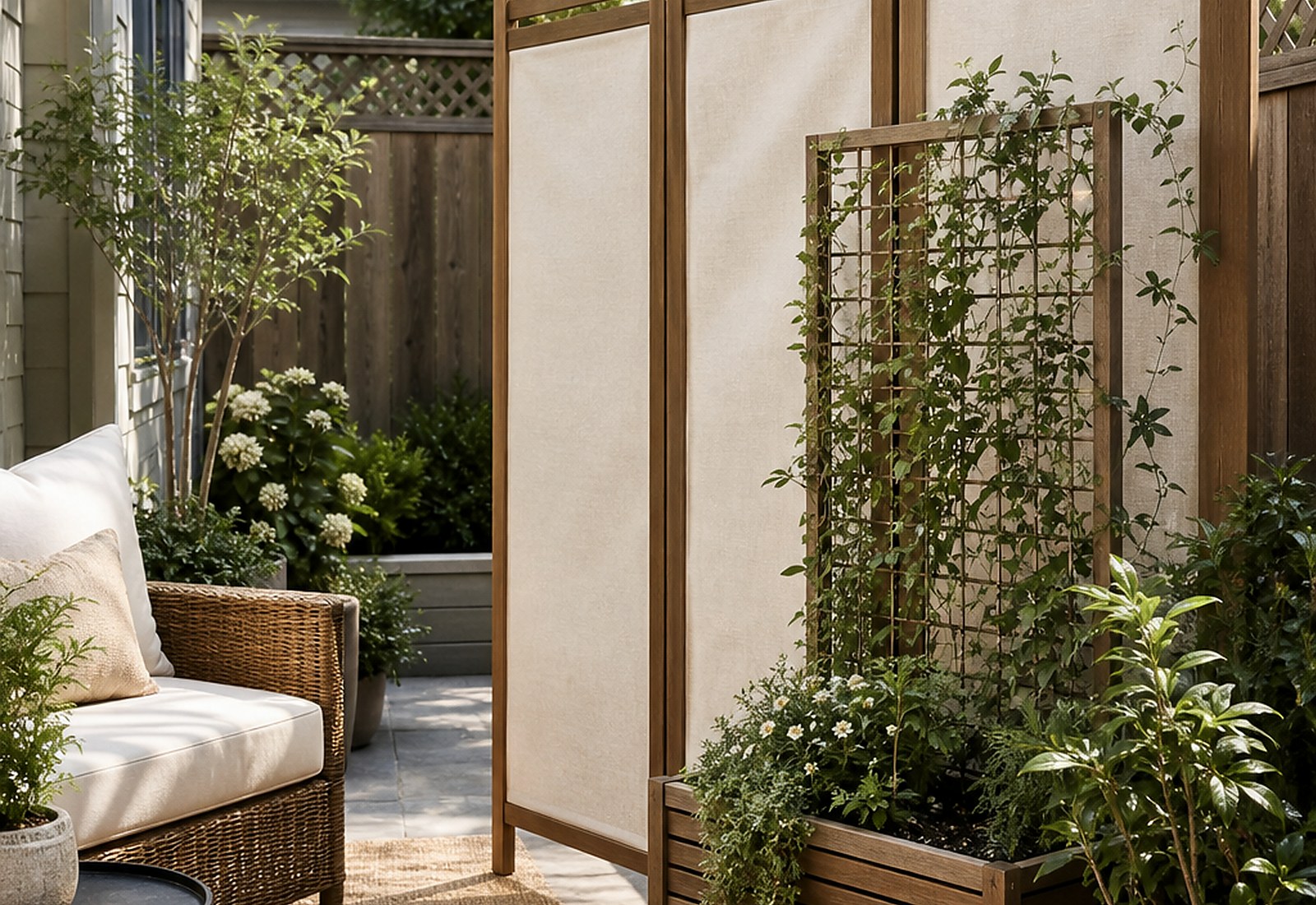
In a small backyard, privacy is usually a line-of-sight problem, not a perimeter problem. A neighbor's raised deck, one kitchen window, or a path beside the patio can make one seat feel exposed while the rest of the yard is fine.
The direct answer: sit or stand at the place you want to protect, identify the viewer's position, and place the smallest screen near your activity area that interrupts that line. A close screen can be shorter and narrower than a screen at the property line. It also preserves more light and usable ground.

Measure the sightline before measuring a product
- Mark the protected point. Put tape where your head is when seated at the table, standing at the grill, or opening the back door. These are different heights.
- Mark the viewer. Use the neighbor window, deck edge, sidewalk, or alley as the second point. Do not assume every direction needs coverage.
- Test a screen location. Hold a sheet, cardboard panel, or open umbrella where a screen could stand. Move it toward the seat until it blocks the target without closing the whole yard.
- Record width and height. Measure the tested rectangle, then add only the overlap needed to cover normal head movement. Product height from the ground is not the same as blocked height above your seat.
- Record the base and route. Measure the feet, planter, anchors, gate, door swing, walking width, and access needed to clean or prune behind the screen.
- Check light and wind. Repeat the test when the sun and wind come from the troublesome direction. A solid panel creates more shade and wind load than an open trellis.
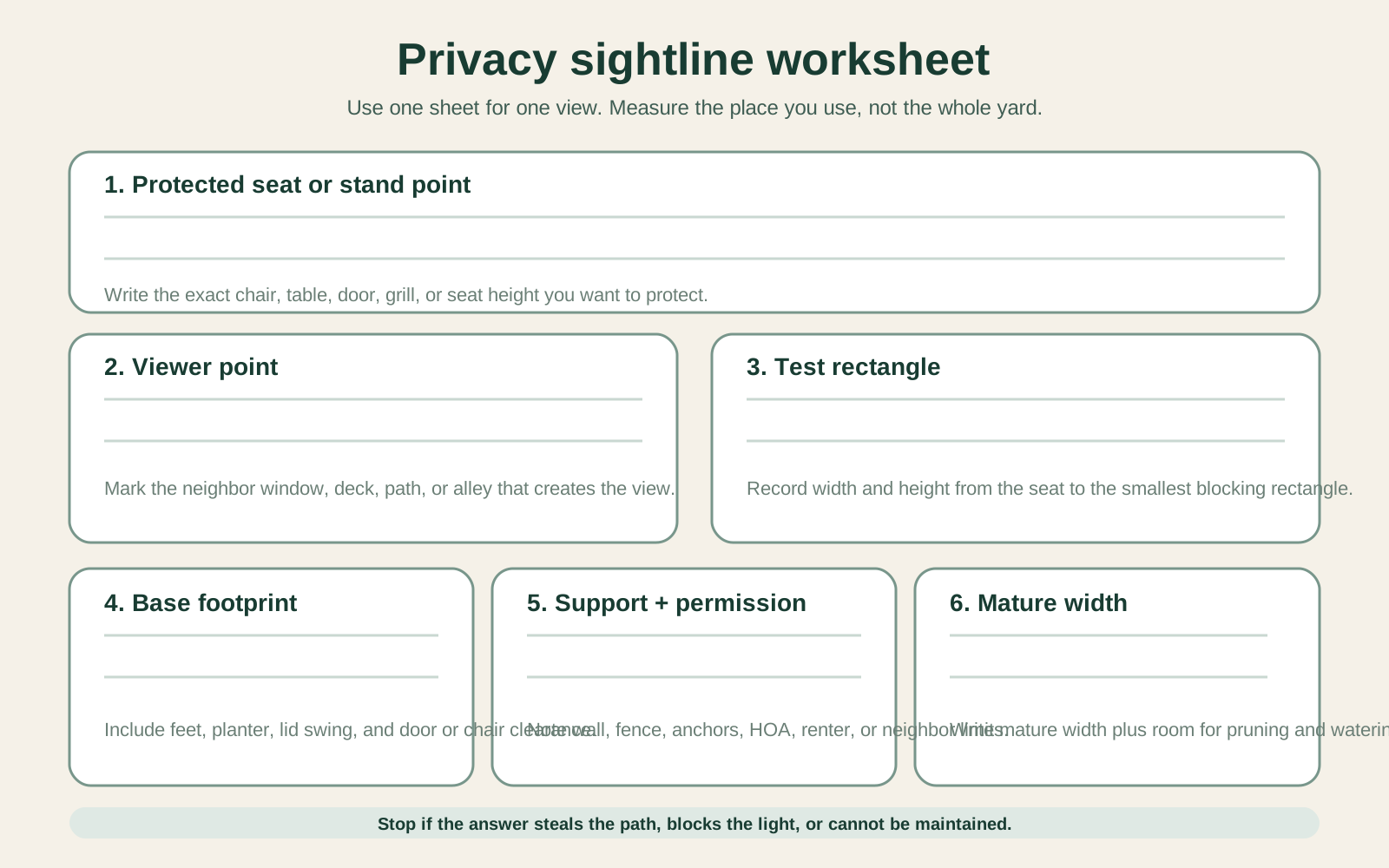
Privacy sightline worksheet
Protected seat or stand point
- Why it matters
- The screen only needs to block the place you actually use.
- Stop if blank
- You do not know which view to solve.
Viewer point
- Why it matters
- Neighbor window, deck, path, or alley height changes the needed screen height.
- Stop if blank
- You are guessing at the angle.
Test rectangle
- Why it matters
- Width and height tell you whether the screen can block the right sightline.
- Stop if blank
- The product photo may look right but still miss the view.
Base or planter footprint
- Why it matters
- The ground width decides whether the screen steals the patio or blocks a path.
- Stop if blank
- The base will make the yard less usable.
Support and permission
- Why it matters
- Wall mounts and fence attachments only work when the structure and rules allow them.
- Stop if blank
- You cannot confirm what will carry the load.
Mature width and access
- Why it matters
- Plants need room to stay healthy and to be pruned from both sides when needed.
- Stop if blank
- The plant will outgrow the strip or become unmaintainable.
Choose the narrowest option that can do the job
Four privacy routes for one exposed view
Rigid panel
- Use it when
- You need immediate coverage and can follow its installation instructions
- Space cost
- Complete feet, base, or post footprint
- Main failure
- Its required support does not suit the surface or wind exposure
Mounted mesh or faux foliage
- Use it when
- A sound fence, railing, or frame already exists
- Space cost
- Very little ground width
- Main failure
- Loads a structure that was not approved for the added wind force
Planter trellis
- Use it when
- You want a softer screen and can water, train, and prune
- Space cost
- Planter depth plus access
- Main failure
- The empty trellis gives little privacy while plants establish
Narrow hedge or small tree
- Use it when
- You own the site and can wait for growth
- Space cost
- Mature plant width plus pruning access
- Main failure
- A nursery-width plant outgrows the strip or thins in shade
What to confirm for each route
The same question repeats in every route: how much of the yard do you lose while solving the one view that feels exposed?
Rigid panel: match the support to the surface
Check whether the exact model uses feet, ground-installed posts, or attachment to an existing structure. These are different installation routes. A model that requires posts in soil is not a freestanding patio screen. Measure the complete support footprint, not just the panel face. If its instructions do not cover your surface or you cannot follow them, skip that model.
Mesh or faux foliage: useful only with a suitable support
These rolls save ground space but do not supply structure. Confirm ownership, condition, permitted attachment points, and wind exposure before tying material to a fence or railing. Do not attach anything to a neighbor's fence without permission.
Planter trellis: plan for the bare season
Decide whether privacy is needed year-round or only while the patio is in use. A deciduous vine can preserve winter light but leaves the view open after leaf drop. An evergreen screen trades more year-round shade and maintenance for continuous coverage. Use a plant suitable for the local hardiness zone, light, water, and container volume; a community suggestion from another climate is not a universal plant prescription. Leave room for irrigation access, pruning access, and the spread of the planter itself.
Hedge or small tree: use mature width, not the sales photo
Oregon State University Extension advises choosing for mature height and width and warns that large plants need space from fences, structures, neighboring property, and utilities. A hedge also needs room for establishment care and access to both sides where pruning is required. A fast-growing screen can still take years to become effective, and a single-species row can leave a large gap if one plant fails. If the mature width crowds the strip, the plant is the wrong answer even if the nursery pot looks small today.
Do not try to screen a second-story view at the fence by default
A tall screen at the boundary may need to be much higher than a screen beside the patio. It can also block late-day sun, trigger fence or accessory-structure rules, and create a larger wind load. First test a shorter screen close to the chair or table. If the viewer is above you, a small canopy, pergola-style slatted top, or correctly placed small tree may interrupt the downward sightline better than a solid wall, but permits, setbacks, utilities, structural loads, and neighbor impacts must be checked locally. The deciding measurement is the blocked view from the seat, not the height of the fence line.
Three different jobs
Compare only the route your site supports
These are three shopping categories, not tested products or verified listings. Compare a category only after the acceptance card passes. Match the exact selected model to its manufacturer's instructions; search results can mix incompatible sizes and support systems. No price, stock, or installation suitability is promised.
Immediate, limited opening
Rigid outdoor privacy panel
Compare when you need coverage now and know the permitted support method. Verify the opaque area, slat gaps, base or post footprint, and exact installation manual. Reject a soil-post model for a hard patio unless its manufacturer explicitly supports that installation.
Seasonal living screen
Outdoor planter with trellis
Compare only if the full planter fits, watering and pruning fit your week, and privacy can wait. Verify container dimensions, drainage, plant support, and the assembly instructions. The bare trellis may not pass the privacy test, and a filled planter is not automatically a safe anchor.
Existing approved support
Privacy mesh for a fence or frame
Compare only when the support, ownership, and allowed attachments are confirmed. Test the actual material with your lights on, then match roll dimensions and fastening instructions. Skip mesh if it fails your visual requirement; a UV percentage does not establish opacity.
Affiliate links. As an Amazon Associate I earn from qualifying purchases.
Common failures and the cheaper correction
- The screen blocks the yard, but not the balcony. Return to the two sightline points. Move a smaller screen closer to the activity zone instead of adding height along the whole boundary.
- The patio feels dark. Reduce the width, use a more open trellis, or screen only seated eye level. Do not keep adding opaque panels.
- The base steals the walking path. Mark the complete footprint and door swing with tape. Move the screen, choose an approved mounted route, or skip the purchase.
- The plant grows into the fence. Compare mature width with the available strip and reserve pruning access. Replace the plant plan with a slim trellis if the numbers do not fit.
- The screen moves in wind. Stop using it until it can be installed exactly as required. Extra pots or improvised weights are not a verified anchor design.
- The neighbor dislikes the result. Confirm the property line, ownership, local rules, and maintenance access before installation. A privacy fix should not depend on entering their property later.
Will it hide the view after dark? Test material, not just dimensions
A cardboard mock-up proves the shape and location, not the privacy of mesh, slats, or foliage. Before buying a full roll or several panels, separate three questions: does the rectangle intercept the view, does the actual material hide enough, and can the complete assembly be installed there? Passing one does not answer the others.
Set a specific acceptance rule: for example, “someone at the shared path should not be able to see my seated face through this opening.” That is a personal test target, not a certified privacy rating. If your aim is only to soften the view of bins, partial screening may be enough. If the aim is to stop a direct view into a lit room, do not assume an outdoor mesh screen will do it.
Run the same check in three conditions
- Daylight: test the real material or a manufacturer sample at the planned angle. Keep the seat, viewer position, distance, and panel orientation consistent. Check through the middle and past both edges. Use only positions you may legally access; do not enter a neighbor's property to complete the test.
- Evening with your normal lights on: repeat the check when the patio or room behind the screen is lit. Write down whether you can distinguish a face, body outline, or only movement. A result in one lighting condition is not a promise for another. Do not use a camera's automatic exposure as the only judge.
- The least-covered season: for a planter trellis or hedge, sketch the bare framework and existing gaps. If year-round privacy matters, the plan must address that state rather than relying on a summer photograph or hoped-for growth.
Use a temporary sample only where you can hold it safely without climbing, obstructing a route, or improvising an attachment. Do not leave a sheet or mock-up outside unattended, and do not test in strong wind. This exercise does not test structural safety or establish an anchoring specification.
Read the percentage next to its actual claim
Coolaroo's fabric categories label percentages as UV block. That is not a statement that the same percentage of your view disappears. Record whether a listing says UV protection, shade, or visual screening, and ask the manufacturer about the exact material if the wording is unclear. Do not turn a UV number into a nighttime privacy guarantee. We have not independently tested these fabrics.
Privacy acceptance card: one opening, one candidate
Fill in these eight fields, then copy them to your notes. This card has no submit button, saves nothing on this site, and does not send your entries to analytics. Reloading may clear them. Do not enter addresses or neighbor names.
Use the failed check to change the purchase
- The center passes but the edges fail: retest the position and needed overlap. A denser roll does not close a side gap.
- Day passes but evening fails: reject that material for a lights-on privacy requirement. Compare a more opaque, properly supported option or address the room opening itself; do not order more of the same mesh.
- Summer passes but the bare frame fails: accept seasonal privacy explicitly or choose a separate year-round solution. Adding more containers also adds watering and usable-space costs.
- Coverage passes but the support is unknown: hold the purchase. Neither a good photograph nor a heavy planter proves wind stability. Follow the exact assembly instructions and seek qualified advice when the site falls outside them.
A Houzz owner seeking a narrow screen beside a drainage swale also needed immediate coverage without blocking water or maintenance access. Another small-yard planting discussion raised fence ownership and loss of winter coverage. These are useful planning questions, not evidence that a particular species, height rule, or installation will work at your address.
For a patio layout that preserves walking width, continue with the small patio layout guide. If the screen includes planters, use the watering comparison only after the containers and water route are fixed. If the goal is to hide stored tools rather than people, the outdoor storage guide may solve the problem with less added screening.
Sources and limits
The planning boundaries were checked against Oregon State University Extension's tree-selection guidance and its privacy-screen guidance. Community questions that revealed the missing decisions included Houzz discussions about choosing the exact place that needs privacy, screening one viewpoint in a 13-by-43-foot yard, and a hedge that may outgrow a narrow strip, plus Gardening & Landscaping Stack Exchange questions about a raised balcony sightline and light and maintenance behind a hedge. Community cases identify questions, not universal plant, engineering, code, or product answers.