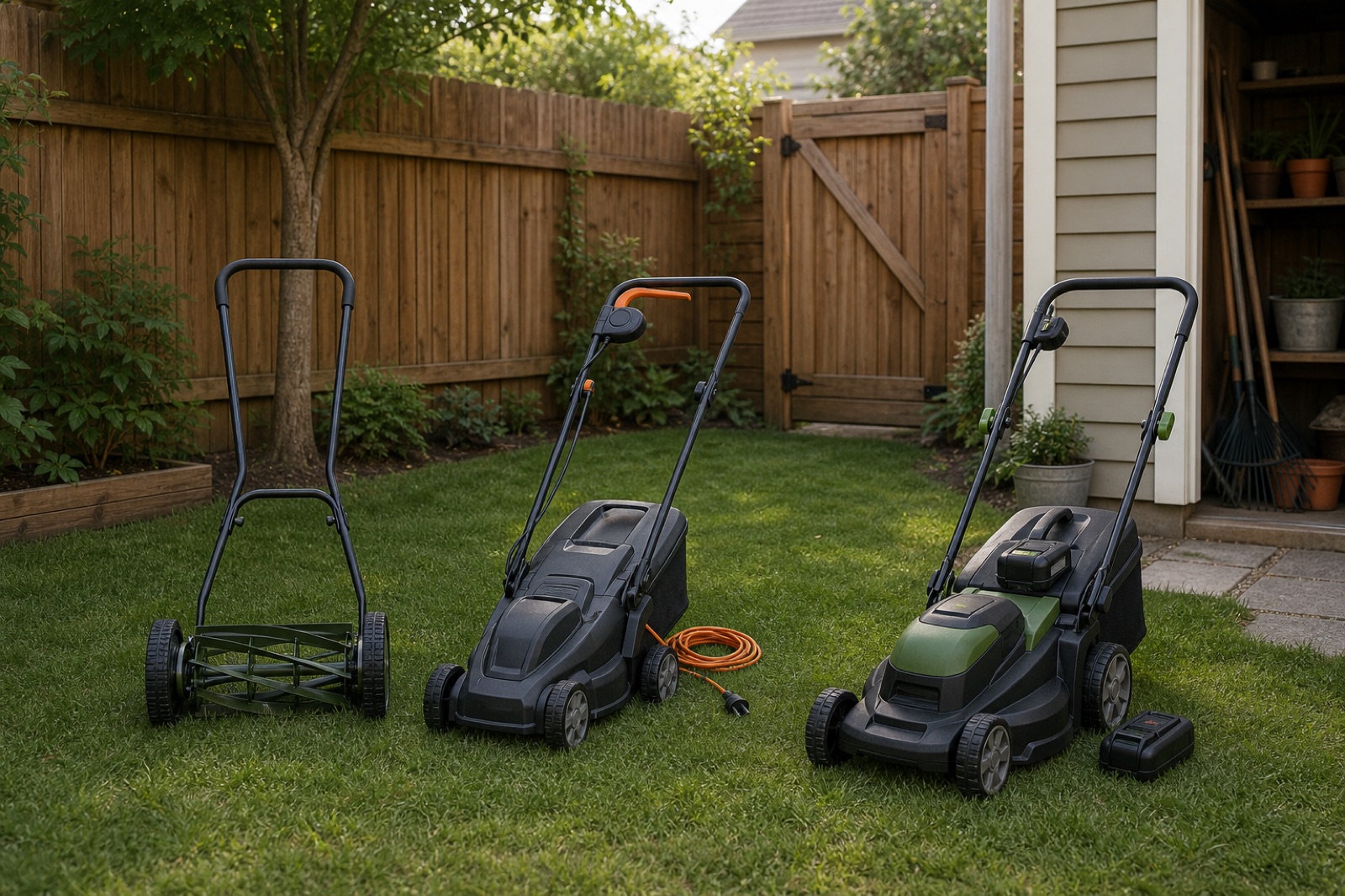
The short answer
Choose a manual reel mower when the lawn is fairly smooth, level, kept short, and free of frequent twigs. It avoids a cord, battery, motor, and charging space. It is a poor match for rutted ground, neglected tall growth, or a route that makes pushing and turning difficult.
Choose a corded electric mower when the lawn is small, open, and reachable from a suitable outdoor power point without wrapping the cord around beds, trees, steps, or furniture. The cable is part of the mowing job. If you cannot plan a path that keeps it behind you and away from the cutting deck, choose another format.
Choose a compact battery mower when turns, beds, and obstacles make a cord impractical and the measured lawn fits one realistic cutting session. Check the full stored size, folded handle, battery system, charger location, replacement-battery cost, and the machine's weight on the route you will actually carry or push.
Do not buy a mower yet when the lawn takes only a few minutes but the machine needs a risky lift, blocks the only dry storage area, or spends more time being carried, unfolded, cleaned, and stored than cutting. Borrowing, hiring occasional help, or replacing part of the turf can be the more useful answer.

Five measurements
Write down what the product photo cannot show
- Mowable area and shape: measure only the turf you will cut. Separate open rectangles from narrow strips between beds. A tiny total area can still contain many turns.
- Surface condition: walk the lawn and mark ruts, exposed roots, stones, soft ground, steep sections, and places where a wheel drops or a reel loses contact.
- Narrowest clear width: measure gates, side passages, bed gaps, and the space beside furniture. Include the mower deck, wheels, grass catcher, handle angle, and room to turn.
- Storage-to-lawn route: count steps and tight turns. Note any slope, threshold, or lift. Test the route with the handle in its working position, not only folded.
- Power and dry storage: trace a safe cord path or identify a dry charging and storage location. Record setup, cutting, cleanup, and putting-away time as one job.
Compare the four real options
| Format | Strong starting fit | Main work it adds | Stop signal |
|---|---|---|---|
| Manual reel | Smooth, level lawn kept short with frequent passes | More pushing; blade contact and adjustment matter | Ruts, tall wet grass, twigs, or uneven cutting |
| Corded electric | Small open lawn with a simple outlet-to-finish route | Managing an outdoor-rated cord every pass | Cord crosses obstacles, gates, steps, or the cutting path |
| Compact battery | Small lawn with turns where a cord would be awkward | Charging, battery storage, and future pack replacement | Runtime is unclear or weight makes the storage route unsafe |
| Borrow, hire, or reduce turf | Very small, occasional, inaccessible, or difficult lawn | Scheduling or a one-time layout change | Repeated service costs exceed a mower that safely fits and will be used |
1. Manual reel mower: simple only on the right surface
A reel mower cuts with a moving reel against a stationary bed knife. That contact needs attention. A sharp, correctly adjusted mower on smooth turf is a different experience from the same mower on bumps, sticks, or grass that has grown too tall between cuts.
Walk the lawn in two directions before buying. If the wheels repeatedly drop into ruts or the mower would strike exposed roots, fix the surface or choose another method. Also look at the normal mowing schedule. A reel mower usually asks for more frequent passes rather than a rescue cut after long growth.
Check cutting width, cutting-height range, handle fit, mower weight, wheel clearance, and how the reel and bed knife are adjusted. Do not choose the widest deck automatically. A narrower reel can turn through beds and gates more easily, while a wider one needs fewer straight passes on an open rectangle.
Compare the format: Manual reel mowers for small lawnsCompare on Amazon
Affiliate link. Compare dimensions and manufacturer instructions on the current listing; this is not a claim that every result fits your yard.
2. Corded electric mower: the route is the feature
A corded mower removes battery charging and pack replacement, but it adds cable planning to every pass. The cleanest route starts near the power source, moves away from the cord, and keeps the cable behind the operator. A small rectangle can make this predictable. Beds, trees, a gate, and several narrow strips can turn it into constant cable handling.
Draw the outlet and lawn on paper. Trace each pass. If the cord must cross the deck path, wrap around a planter, lie on a public walkway, or stretch through a doorway, the low purchase price is not solving the whole job. Use only the power arrangement and extension cord specified by the mower manufacturer, and follow local electrical safety guidance.
Check the mower's folded depth, cord connection, deck width, catcher clearance, handle controls, and the path back to dry storage. A corded mower should not be chosen because the lawn is small if the cable route is poor.
Compare the format: Compact corded electric mowersCompare on Amazon
3. Compact battery mower: no cord does not mean no constraints
A battery mower can make turns and divided lawn sections easier because there is no trailing power cable. The useful comparison is not the largest advertised runtime. It is whether the mower can complete your measured lawn under the height, moisture, bagging, and terrain conditions stated by the manufacturer.
Record the battery voltage platform, included battery count and capacity, charger, replacement availability, folded dimensions, mower-only weight, working weight, and how the pack is stored. If you already own compatible outdoor tools, one battery platform may reduce duplicate chargers. That is only useful when the mower itself fits the lawn and route.
Do a lift-free route test before ordering. If the only storage space requires carrying the mower up steep steps, a lighter machine, different storage location, or hired mowing may be safer than a more powerful model. Do not rely on a folding handle to solve a narrow route unless the mower can actually be moved that way according to its instructions.
Compare the format: Compact battery mowers for small lawnsCompare on Amazon
Uneven ground changes the answer
Gardeners asking about reel mowers repeatedly describe the same split: a smooth, frequently cut lawn can feel manageable, while holes, bumps, twigs, and uneven growth cause stopping, scalping, missed strips, or extra passes. That is a surface problem, not a reason to keep buying different reel models.
Mark the rough areas. Fill small depressions only with a method suitable for the turf and season in your region. Address exposed roots, stones, drainage, or erosion before trying to force a low deck across them. If the lawn cannot be made reasonably even, compare a mower designed for the terrain, reduce the turf around the obstacle, or use professional help.
Do not use a generic slope number from another product. Follow the slope and operating limits in the exact mower manual. If you cannot keep stable footing, control the machine, and maintain a safe route, stop and choose a different way to manage that area.
Measure the gate, bag, and turn together
Listed deck width is not the same as the full working width. Wheels, axles, guards, cable guides, and a rear bag can add space. The handle may also swing outside the deck when turning.
- Measure the narrowest clear opening after subtracting hinges, latches, pots, bins, and anything that cannot move.
- Compare that number with the manufacturer's full mower dimensions, not only cutting width.
- Mark a turning box on the ground with tape or chalk. Include the catcher if you plan to bag clippings.
- Trace the storage route with doors open. Check whether the handle can remain in a safe carrying or rolling position.
- Leave walking clearance. A mower that technically enters the shed can still block every other tool.
Use total job time, not lawn size alone
For two ordinary mowing sessions, record four numbers: setup, cutting, cleanup, and storage. This turns a vague small-lawn claim into your own comparison.
Setup
Unlock storage, unfold the handle, attach the bag, route the cord, or install the battery.
Cutting
Include turns, missed strips, obstacle trimming, and stops to clear the path.
Cleanup and storage
Empty the bag, inspect the deck safely, coil the cord or remove the battery, and return the mower to a dry spot.
If cutting takes six minutes but setup and storage take fifteen, a larger or more complicated mower is unlikely to improve the whole job. A reel mower stored beside the lawn, a borrowed machine, or less turf may save more time than a higher specification.
Will a reel mower still fit after a missed cut?
Test your normal routine, not only a freshly prepared lawn. A short cutting time can hide repeated passes, edge work, or a separate cleanup machine. Do not deliberately let grass overgrow for a test. Record an ordinary session and, if a delay happens naturally, note what changed before deciding how to recover.
- Choose one representative patch and mark its boundaries without leaving objects in the mowing path. Include an ordinary turn, but avoid unsafe slopes or damaged ground.
- Before mowing, record days since the last cut, approximate grass height and whether tall stems are scattered or widespread. Use the same units throughout. These observations describe conditions; they do not diagnose the grass species.
- Clear the area, follow the exact mower manual, and keep people and animals away. Start the timer when retrieving the mower, not when the blade first reaches grass.
- Record initial cutting separately from repeat passes and edge work. Stop if the mower jams or pushing becomes unsafe. Shut down as instructed before inspection; never inspect a moving cutting assembly.
- Finish the clock after cleanup and storage. Compare a second ordinary session on the same area. Different grass height, moisture or bagging makes a simple speed comparison unreliable.
Only isolated stems remain
Record the number and location, plus extra finishing minutes. A separate suitable hand tool may be manageable for a few stems, but its time belongs in the total. Repeated whole-lawn finishing is a different workload.
Most of the patch needs another pass
Check permitted adjustment and maintenance in the manual. If the same problem returns under suitable conditions, compare another mower format or a service. Do not assume sharpening alone solves every mismatch.
A delay creates a rescue job
Use local grass-height guidance and a suitable machine or service for recovery. Do not force a low setting through long growth. Ask whether your realistic schedule supports this mower, including travel and wet-weather delays.
Cutting works; access consumes the day
Compare a nearer safe storage position or a simpler setup before paying for a larger deck. Use the storage clearance guide to check the full route.
Two-session mowing record
Enter “A / B” values for two sessions. This worksheet does not save or transmit entries; copy them before leaving. Blank is unknown, not zero.
Worked example, not a test result: 4 minutes setup + 8 cutting + 7 finishing + 6 cleanup/storage = 25 minutes. Cutting alone is only 8 of 25 minutes. Even a hypothetical 4-minute reduction in cutting would leave a 21-minute job; it would not halve the whole task.
These observation prompts are our planning framework, not a certified performance test. Community reports of missed growth and extensive finishing work informed it. We do not recommend the homemade blade or wheel modifications proposed in those discussions.
Cutting height and schedule still matter
University of Minnesota Extension advises using sharp mower blades and avoiding removal of more than about one-third of the leaf blade in one mowing. Its recommended heights are for the lawn grasses and conditions it describes, so use regional Extension guidance for your own grass type and climate rather than copying one universal height.
The buying consequence is useful everywhere: compare the mower's height range and adjustment method with the grass you have, then plan a schedule that avoids repeated rescue cuts. A mower that reaches the desired height but is awkward to adjust may stay at the wrong setting.
Source: University of Minnesota Extension mowing practices.
Do the safety check before the first pass
- Read the manual for the exact mower and keep all guards and controls in place.
- Clear stones, sticks, toys, wire, and other objects that could be struck or thrown.
- Wear sturdy closed footwear and eye protection. Keep children, pets, and bystanders away from the work area.
- Stop the mower and follow the manual's shutdown procedure before checking, cleaning, adjusting, or reaching near the deck. Unplug a corded mower or remove the battery when instructed.
- Do not mow when footing or visibility is poor. Do not improvise on a slope or carry a machine in a way the manufacturer does not permit.
Arkansas Cooperative Extension includes pre-mowing debris removal, eye protection, sturdy shoes, keeping others clear, and safe shutdown among its lawn-mower safety practices. Product instructions and local guidance should control your setup.
Source: Arkansas Cooperative Extension lawn-mower safety guidance.
When not to buy a mower
- The lawn is temporary: wait through a growing season before buying around a layout you already plan to change.
- The route is unsafe: do not make a steep stair carry part of a weekly routine just because the mower fits the lawn.
- The ground needs repair: fix drainage, ruts, roots, or debris before treating poor cutting as a product problem.
- The turf is the unwanted chore: test a smaller grass area, wider bed edge, or mixed planting before replacing one mower with another. Start with the clover, grass, and mixed-lawn comparison.
- The job is rare: compare borrowing, renting, or a local service with storage, maintenance, and replacement costs.
Product-page checks that prevent a bad fit
- Full product width, depth, and height in use and folded
- Cutting width and cutting-height range
- Grass catcher dimensions and whether it is included
- Mower weight in the working configuration
- Reel and bed-knife adjustment or powered-blade service instructions
- Cord and power requirements for a corded model
- Battery, charger, replacement-pack availability, and storage instructions
- Manufacturer limits for slope, moisture, debris, transport, and storage
- Current return terms and access to replacement parts
Do not compare only deck width, voltage, or advertised runtime. Those numbers cannot show whether the machine clears the gate, turns beside the bed, or reaches dry storage without a risky lift.
Questions small-yard owners ask
Is a reel mower enough for a small lawn?
It can be when the turf is reasonably smooth, kept short with frequent mowing, and free of repeated sticks and rough spots. Test the surface and check the reel adjustment requirements before buying. Small area alone does not guarantee a good reel-mower fit.
Is a corded mower worth dealing with?
It can fit one small, open lawn with a simple outlet-to-finish route. Draw the mowing pattern first. If the cord must cross the cutting path or wrap around several obstacles, the cable work may outweigh the lower equipment complexity.
How much battery runtime do I need?
Measure one real mowing session, including difficult sections and bagging if you use it. Then compare that need with the manufacturer's conditions and included battery. Do not assume the largest advertised runtime will apply to tall, wet, or dense grass.
Should I buy a self-propelled mower for a tiny yard?
Only when the route and terrain make the added drive useful and the extra weight, controls, turning behavior, cost, and storage still fit. For a level lawn with many tight turns, a lighter push mower may be easier to place and reverse.
Where should a mower be stored without a garage?
Use a dry, secure location that follows the manufacturer's storage instructions and protects the machine, cord, or battery from weather. Measure access and ventilation before buying a deck box or cabinet. The outdoor tool storage guide compares storage formats by damp, access, and stored footprint.
Sources and limits
This page is a measure-first format guide. It does not claim hands-on testing of every mower or predict runtime for an unmeasured lawn.
Community discussions were used to identify the decision gaps: manual reel mower practices, outdoor mower storage without a garage, and Houzz discussions about moving a mower along a difficult hill route, matching a mower to uneven ground, and choosing among mower formats. These are problem signals and individual experiences, not proof that one mower works for every yard.
For the broader tool decision, return to Garden Tools for Small Yards. If mowing itself is the problem, use the low-maintenance landscaping guide before buying a more complicated machine.